Budget

Campaign season can get heated, and sometimes people say things that don’t reflect the kind of community we want to build together. I’m choosing to stay focused on what matters — serving Duvall and leading with respect and transparency. I believe voters deserve campaigns based on ideas and solutions. This biennium’s (2025–2026) budget reflects our current community input and available resources. It’s flexible and designed to meet present needs while giving the next mayor and council full freedom to adjust priorities.

Using accumulated cash balance for what residents value doesn’t create future obligations, it simply gives us time to pilot community-supported ideas and engage residents about what they’d like to continue. This approach is a standard practice in local government, and we also maintain healthy reserves. Each biennium starts fresh. Future councils and residents will decide whether to continue, modify, or discontinue programs based on updated revenues, needs, and feedback. Some parts of the budget are required by law, some reflect long-standing community priorities, and a smaller portion is discretionary.

I know our staff and elected officials are committed to cutting costs and maximizing every taxpayer dollar. My goal is to make sure residents understand how and why spending choices are made, and to invite them into those choices. We’ll do that through public budget workshops, online engagement, and a citywide survey to understand which nonessential programs matter most to you.

Nothing in this budget is permanent. Right now, we’re laying the foundation to discover what our community values most, what we can afford, and- if we can’t sustain everything within existing resources- whether there’s willingness to fund certain priorities through a levy or other funding options. Every answer and perspective is valid, and every resident’s voice will shape the path forward.

Click on the #budget hashtag below the photo to see all my Budget Related Posts from as early as February of this year!

A few things

As ballots arrive, I’ve noticed heightened online discussion and some understandable questions about the city’s budget.

Maintaining fiscal responsibility is essential — I agree we should never shift new costs onto residents without careful scrutiny. But claiming a blanket “$2 million deficit” without context is misleading.

First, municipal budgets are made up of multiple funds; a shortfall in one doesn’t automatically mean a crisis across the board. Second, Duvall maintains healthy reserves and mitigation funds precisely to absorb swings. Third, promising “no tax increases, no burden to residents” may sound reassuring, but real balance often requires tough choices: trimming non-essential programs, renegotiating contracts, prioritizing capital projects, or phasing adjustments over time.

As a voter, I’d want to hear how a candidate plans to make those trade-offs — which cuts they’d propose, or how they’d involve the community in that discussion.

As mayor, I’ll continue to insist on transparency: show which line items are unsustainable, present real alternatives, and walk residents through the trade-offs. I won’t rely on slogans or vague assurances. If there’s a structural gap, we’ll address it steadily and openly — not ignore it. Because trust is built by showing your work, not by promising the moon. Our full budget is online and available to the public here: https://stories.opengov.com/…/published/6MBzSG4wW… I’ll be looking to make this information even more accessible and understandable for residents moving forward.

The City Council recently approved a 0.1% sales tax dedicated to public safety. You can read more here: https://www.duvallwa.gov/…/AB-25-46—Ordinance-1340-on…

As our levy that funds the School Resource Officer at Cedarcrest High School expires in December, it was essential to identify a sustainable funding option for that position and for our police department overall — both of which remain high priorities for our community. Unlike levies, which expire after a set term, this sales tax provides a stable, long-term funding source that ensures continuity in public safety services without repeated renewal campaigns.

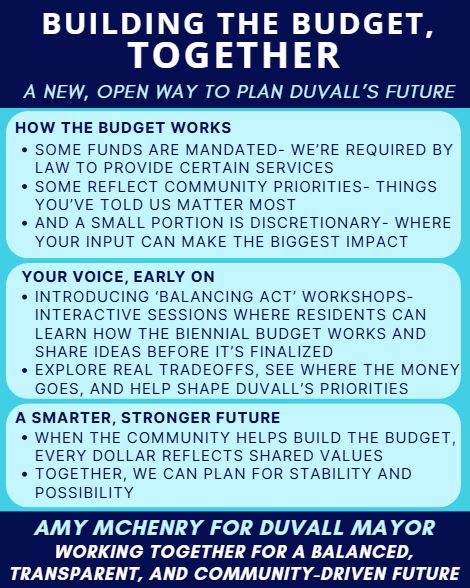
A Better Way to Build Duvall’s Budget—Together

Over the past week, I’ve shared how Duvall’s budget actually works—how our funds are structured, why reserves matter, and how we plan for stability and transparency. Now I want to talk about what comes next—and how I’d like to do things differently as Mayor.

Creating a city budget isn’t just about numbers. It’s about values, priorities, and trust. Some parts of the budget are non-negotiable—things we’re legally required to fund. Others are the community’s clear priorities—like safety, infrastructure, and parks. And then there’s a small portion that’s discretionary, where we have room to make meaningful choices.

That’s where you come in.

I want Duvall residents to have more than a seat in the audience—I want you to have a seat at the table. That’s why I plan to introduce “Balancing Act” workshops, where the community can walk through the real tradeoffs that go into building our biennial budget. These sessions will make the process interactive, educational, and collaborative—so everyone can see how decisions are made and share input before the budget is finalized.

A transparent budget process shouldn’t just inform people—it should invite participation. Together, we can make sure every dollar reflects the priorities of the people who live here.

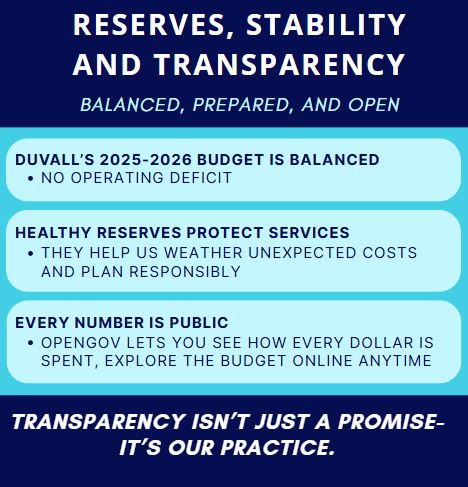
Reserves, Stability, and Transparency

The truth is simple: Duvall’s 2025–2026 budget is balanced.

We maintain healthy reserves across our funds — including our General Fund — to make sure we can weather unexpected costs or economic shifts without cutting services.

This budget uses a portion of those reserves for planned projects and investments- exactly what they’re there for. Those reserves aren’t “extra” money sitting around — they’re a sign of fiscal responsibility. They stabilize our city, protect essential services, and keep us prepared for the future.

And you don’t have to take my word for it. Every budget detail is published for the public to see on OpenGov. Transparency is how we build trust and keep our community informed: https://stories.opengov.com/…/published/6MBzSG4wW…

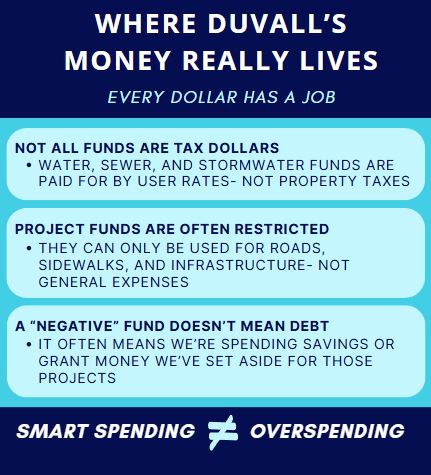
Where the Rest of the Money Lives

When you see numbers in the millions, it’s natural to wonder — is Duvall overspending?

Here’s what’s really happening:

A lot of our budget lives in restricted funds — like water, sewer, and stormwater utilities. Those are self-sustaining and paid for by user rates, not property taxes.

Then there are Capital and Street Funds, which rely on grants, impact fees, and savings for specific projects — like rebuilding 3rd Avenue or improving Main Street crossings.

Sometimes you’ll see a “negative” balance listed for one of those funds. That doesn’t mean the City is in debt — it often means we’re using reserves that were saved for exactly that purpose (for example, spending grant matches or construction savings).

In short: our funds are doing their jobs — maintaining the systems we rely on and investing in future improvements.